

April with Wild Asparagus
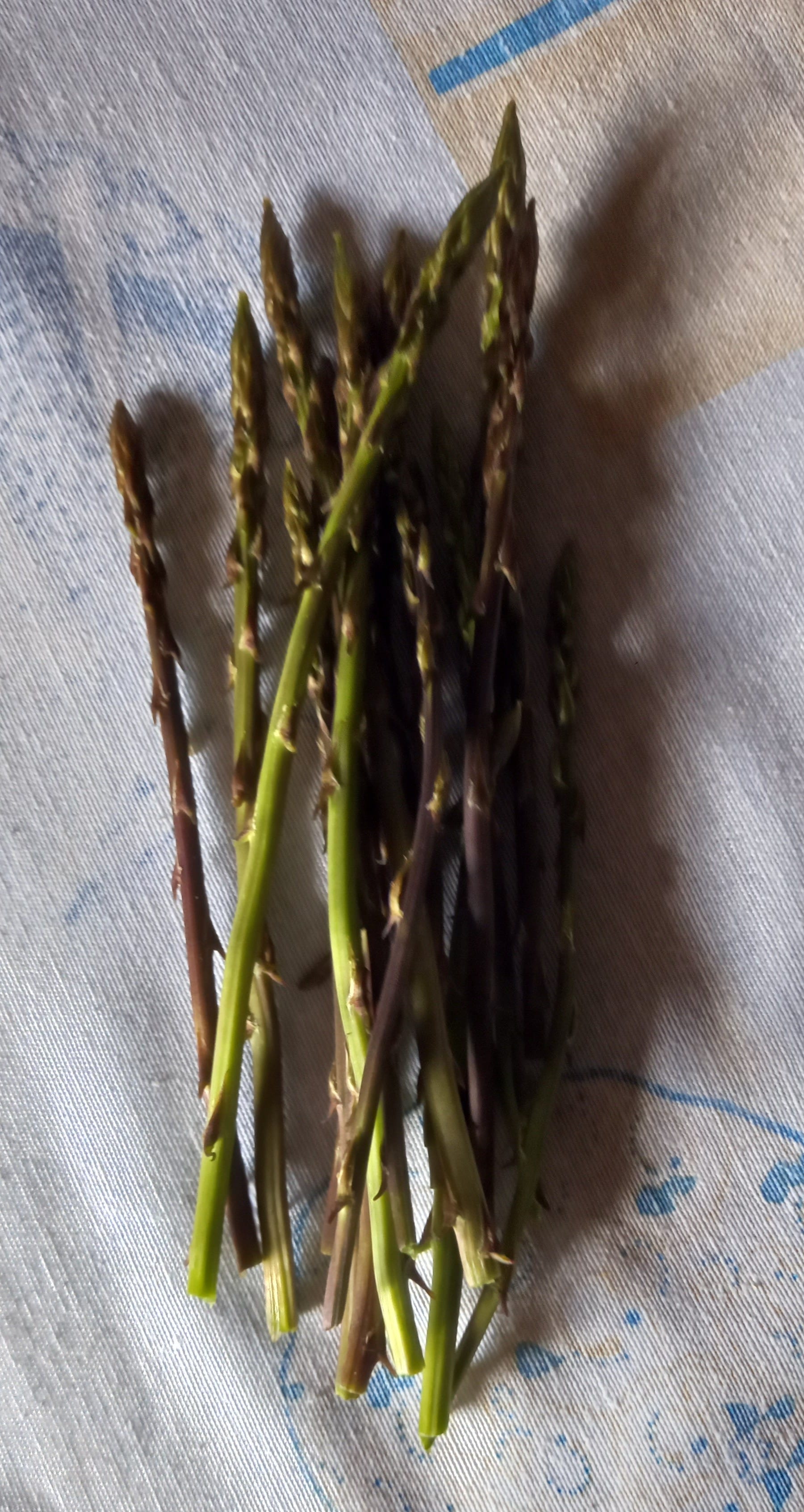
In April, I pick wild asparagus. As a child, I learned from my father. Then, I seemingly forgot all about it, when I moved abroad and was fascinated by other cultures, most of all Scottish and Baltic. Then, I moved back to Italy, and a slow process of feeling a sense of belonging to the land where I live began again.
More than through any superimposed, “current” ideology or agenda, my reclamation passes through reweaving my place in the land, and cultivating relationships to its denizens. Most of all, the local plants and flowers. As a teenager, I inherited a treasure trove of herbal remedies instructions from Luigi, a man I met well in his nineties, who was a geologist and biologist expert about plants.
At this time of the year, I walk the edges of fields and woods, alone or in good company, looking for this nutritious sprout, a plant strongly associated to rebirth, and the first warm sun rays of the year.
In my family, we prepare wild asparagus in a number of ways, ranging from omelette to pasta with asparagus sauce. Still, the simplest way to taste these delicious sprouts is to boil and season them with olive oil, lemon juice, salt and pepper.
Because I would love to connect with more of you, I offer the following discounted subscription options. Pick the best one for you.
Descriptions and Uses
Asparagus belongs to the Liliaceae family. It is a herbaceous, perennial plant, which can grow up to 1.5 m tall. While it is bushy, its trunk is smooth, supple, and heavily branched. The flowers appear in June and July, are yellowish, almost transparent, pendulous, and bell-shaped. They can be solitary or there can be two on a single stalk. The leaves look more like scales and are clustered in groups of 3-9 (cladodes). The fruits are red berries containing a large, black seed inside.
There are cultivated varieties of asparagus, either for culinary or ornamental reasons, but you can find that wild asparagus thrives in the undergrowth, despite being a solar plant. The edible part is the shoot that emerges from the base of the plant. The roots instead are used for medicinal purposes. The shoots are harvested in Spring, the roots in Fall. If you want to preserve the shoots, you can freeze them, whereas to preserve the roots you need to let them dry in the sun, and store them in small bags or glass jars.
Recipes
Below are a few of the best recipes I learned from my mother.
